
THE BOOK
The Holy Theory
On the Failure of Thought and the Foundation of the Unthought
AN INQUIRY INTO THEORY ITSELF
What is Theory?
The Holy Theory: On the Failure of Thought and the Foundation of the Unthought begins with a deceptively simple question: What is theory?
So much depends upon the answer because every explanation you accept, every tenet you hold, and every conception of yourself, the world, and the cosmos exists within theory.
Formulating an answer throws open the blinds onto the book’s immense landscape: the identification of the constituents, constraints, architecture, and meaning of a complete and consistent theory of everything—that is, everything across all domains, known and unknown, from physics to phantasmagoria.

Antoni Gaudí's hanging-chain model of Colònia Güell. Structural form emerges from constraint.
THE LIMITS OF THEORY
Where Theories Fail—And What Happens When They Do
In training the klieg lights on theory itself—not one of a particular field or discipline—the book requires the reader to come face to face with theory’s spotty history, changing meaning, ultimate purpose, and myriad problems.
It highlights how, across philosophy, science, and theology, attempts to construct comprehensive frameworks continually come up short due, in varying ways, to constraints of scope, scale, perspective, or spatiotemporal framing.
These constraints determine what theories can include, how they are formulated, and where they ultimately collapse under misguided assumptions, empirical shoehorning, and other structural burdens.
Reviewing these issues reveals a striking, if brutal, consequence: as theories increasingly lose their ability to effectively explain, describe, predict, and control their respective systems, the structure and function of civilization have begun to fracture.
That fracture is spreading.
Deepening.
Accelerating.
THE FOUNDATION
What Must A Complete Theory Contain?
Against this backdrop, the book sounds a clarion call to humankind.
Now, more than ever, we must establish what theory is—what it must admit, preserve, organize, and constrain to become internally consistent, coherent, and intelligible across microcosmic and macrocosmic realms, subjective and objective perspectives, and evolutionary and developmental processes—without reducing one domain to another.
Heeding this call means extending the domain of theory beyond its traditional bounds, introducing what prior frameworks tend to exclude yet upon which their completion depends.
The Holy Theory thus establishes the requirements—the conditions, the materials, the constraints, the model—from which a complete framework becomes possible.
Again: no theory is presented.
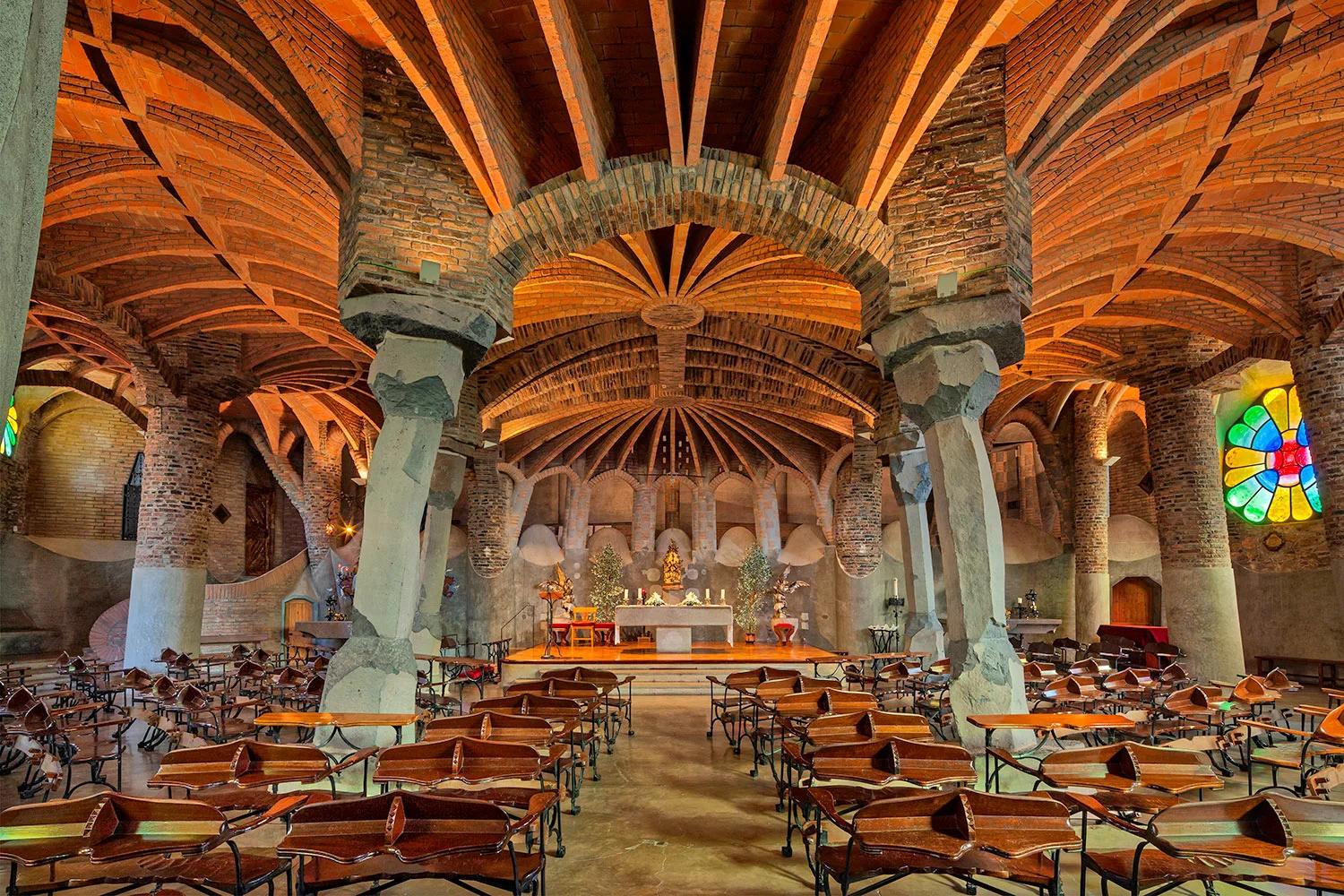
The crypt of Colònia Güell, showing the constructed architecture associated with Gaudí's model.
THE TITLE
Why Holy?
Saying the word holy immediately calls to mind religiosity: consecrated to God; sacred; divine; morally pure.
But holy is polysemic, meaning it has multiple meanings.
Etymologically and historically, holy is associated with wholeness, integrity, soundness, and health—meanings that stubbornly persist beneath its modern usage.
The theological register of holy is thus retained, but no religious commitment is required of the reader.
PUBLICATION STATUS
Where the Project Stands—And for Whom
As of October, 2026, the manuscript—representing the first volume of a four-volume project—is complete at 79,000 words.
It fits serious adult nonfiction in big ideas and science and philosophy and has been professionally edited and reviewed by independent peers.
The Holy Theory is written for readers seeking a Baedeker to reality: a book broad enough to speak to civilizational disorientation, disciplined enough to avoid flighty inspiration, and personal enough to include the reader’s own perspective in the discussion.
Men fear thought as they fear nothing else on earth—more than ruin, more even than death. Thought is subservient and revolutionary, destructive and terrible; thought is merciless to privilege, established institutions, and comfortable habits; thought is anarchic and lawless, indifferent to authority, careless of the well-tried wisdom of the ages. […] Thought is great and swift and free, the light of the world, and the chief glory of man.
—Bertrand Russell